


What is unfolding in Senegal is bigger than a political fallout between President Diomaye Faye and Ousmane Sonko. It is the betrayal of a movement.
Faye came to power on the back of a public desire for real change, anti-imperial politics, Pan-African conviction, and a rejection of France’s continued influence in Senegal. That hope was embodied in PASTEF and in Sonko’s politics.
But the rift between Faye and Sonko has shown how quickly a people’s mandate can be weakened when leadership begins to compromise with the same systems it was elected to confront. Africa cannot achieve real progress without political and economic independence.
Senegal has become a warning. A righteous movement can be reversed when it is placed in the hands of leaders who are not fully committed to the cause.
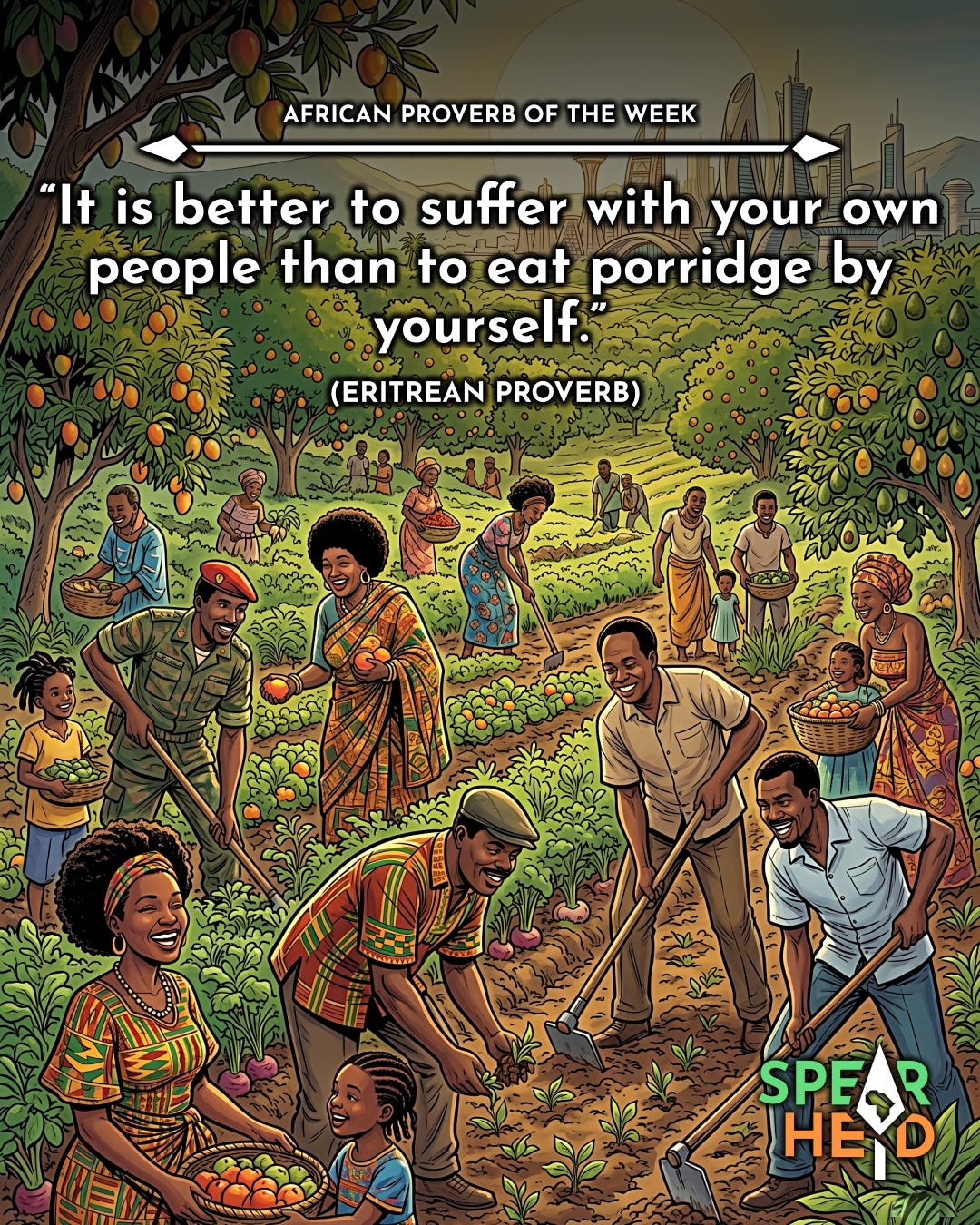
African Proverb Of The Week
In pre-colonial African culture, the collective was viewed as the ultimate source of power. Reality was viewed not as a sum of parts, but a whole, and the community as a circle that could never be broken. Long before the European colonizer ever stepped foot on the African continent, the collective nurtured, protected, preserved and thrived.
Thanks to centuries of colonialism, this truth about the wholeness of reality has been mostly forgotten. Rather than nurture, protect and preserve the whole, many Africans today seek individual success and validation within the colonizer’s system. Blinded by the West’s pathological individualism, they exhaust their time, energy and resources on literally anything but their own collective prosperity, and will happily betray this collective prosperity for the West’s scraps.
Thus the colonial system continues to thrive, and Africa continues to suffer, creating more division, justifying more fragmentation, and the vicious cycle repeats.
This East African proverb reminds us that for Africa to rise again, it must remember its ancient wisdom, and unify against the parasites who forced it to forget. This was the dream of its great modern leaders, like Kwame Nkrumah, Sékou Touré, Patrice Lumumba and Thomas Sankara.
And for the first time in generations, the dream of these great leaders is alive again in the Alliance of Sahel States (AES)
Niger Takes Full Control Of Arlit Uranium Mine, Revokes French Company’s License
Niger has taken another bold step towards the full nationalization of its resources. On May 18th, 2026, the Nigerien government revoked a 58-year-old concession granted to France’s Atomic Energy Commission (CEA) on the country’s fabled Arlit mine. French mining company Orano had been siphoning uranium from this mine to power France’s nuclear reactors for over 50 years before it was suspended from operating in Niger by the administration of President Abdourahamane Tchiani in 2024.
With this latest move by Niamey, Niger, which has relied on neighboring Nigeria to meet the bulk of its energy demands for decades, is closer than ever to finally harnessing its own energy reserves for the benefit of its masses.
As a member of the Alliance of Sahel States (AES), Niger has faced relentless att@cks by Western-backed t£rrorists, economic isolation and sovereignty violations by Western-aligned African states, and endless slander from Western and Western-aligned media. Despite these externally-imposed challenges, the country and its fellow AES members, Mali and Burkina Faso, have continued to record economic and political wins.
All 3 AES members have pointed to former colonizer France as a key sponsor of t£rror in the region – a claim which has been corroborated by their international allies – and France itself has made no bones about its intentions to revive its dwindling influence in Africa, and in so doing, shore up its presently crumbling economy.
EBOLA: Africa Is Not a Dumping Ground for Western Fears
America wants to protect itself from Ebola by moving its exposed citizens to Kenya, a country with no recorded cases of the disease. In plain language, the United States does not want the risk on its own soil, so it wants to move that risk to #Africa.
Kenya’s High Court has now suspended the plan, blocking any Ebola-related quarantine, isolation, or treatment center tied to the US or any foreign government. The case, brought by the Katiba Institute, argued that the plan posed a threat to life if allowed to proceed without proper safeguards.
This is bigger than one facility. It is about how Africa is still treated as a convenient dumping ground for Western fears. When the risk is too dangerous for America, it suddenly becomes acceptable for Africans. Ruto’s government must answer a serious question: why should Africa carry a public health risk that America refuses to carry for itself?
U.S. AFRICOM Signals New Scramble for Africa
The United States is not hiding its desperate scramble for Africa’s mineral resources.
At a Senate Armed Services Committee hearing on May 14, 2026, U.S. AFRICOM commander Gen. Gagvin R.M. Anderson described Africa’s resources, geography, and population as critical to U.S. national security. In the same breath, he framed the continent as the “epicenter of global t*rrorism.”
That language is not accidental.
By presenting Africa as both resource-rich and security-threatening, the U.S. is creating the excuse for a pr*datory empire to do what it does best - destabilize and extract.
Follow The Spearhead on the following platforms:
TikTok - http://tiktok.com/@spearhead_af
YouTube - http://youtube.com/@spearhead_af
Instagram - http://instagram.com/spearhead_af
Threads - http://threads.com/@Spearhead_Af
Facebook - https://facebook.com/spearheadafrica